
Skip to content

Bullion Brains Correlation Matrix

See when bullion is moving with the tape and when the relationship is breaking.

Matrix, rolling regimes, beta, diversification, and signals in one desk.

Map how gold, silver, crude, FX, and the rest of the commodity universe are moving together, then track when those relationships strengthen, fade, or diverge enough to matter.

Correlation desk
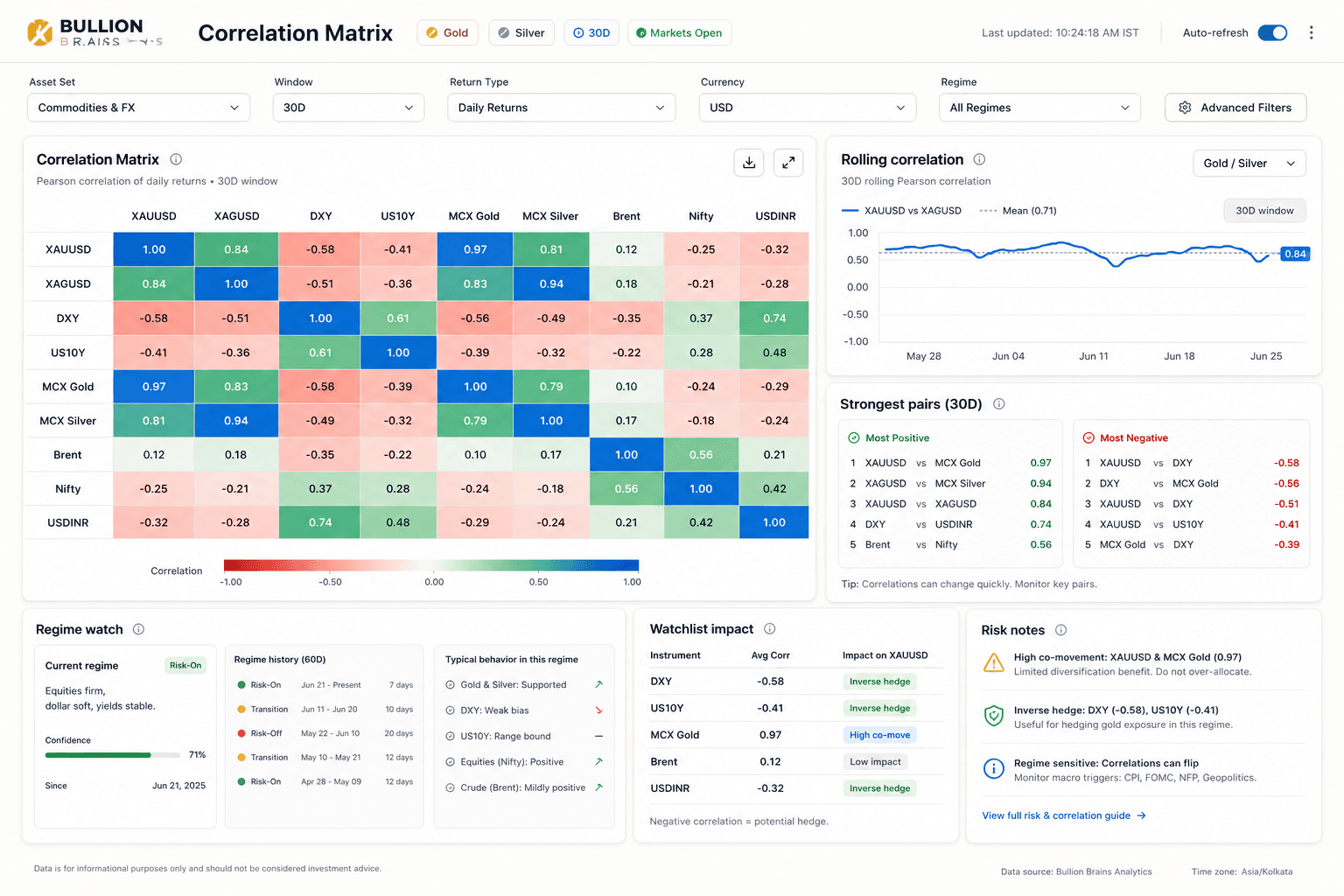
Bullion Brains correlation workspace showing matrix output, heatmap structure, rolling correlation, and signal depth

Real workspace capture showing matrix output, heatmap structure, rolling correlation, and the deeper beta-diversification-signal layer used for cross-asset decisions.

Trader Workflow

Map the relationship. Watch the regime. Act when the edge is real.

The correlation page is built as a working desk, not a one-number calculator. Traders can scan the asset web, judge whether the relationship is stable or changing, and then decide whether the move deserves hedge, sizing, or signal attention.

01

Build the asset set your desk is actually framing risk against

Start with the same matrix workflow the private tool uses: define the asset set, set the history window, and calculate the cross-asset relationship map across bullion, FX, and commodity markets.

Compare gold against silver, crude, FX, copper, platinum, palladium, and natural gas
Read pair-by-pair correlation, strength labels, p-values, and sample depth in one output surface
Use the heatmap to spot tight clusters, weak links, and negative relationships faster than a table scan
02

Watch the regime instead of assuming the relationship stays constant

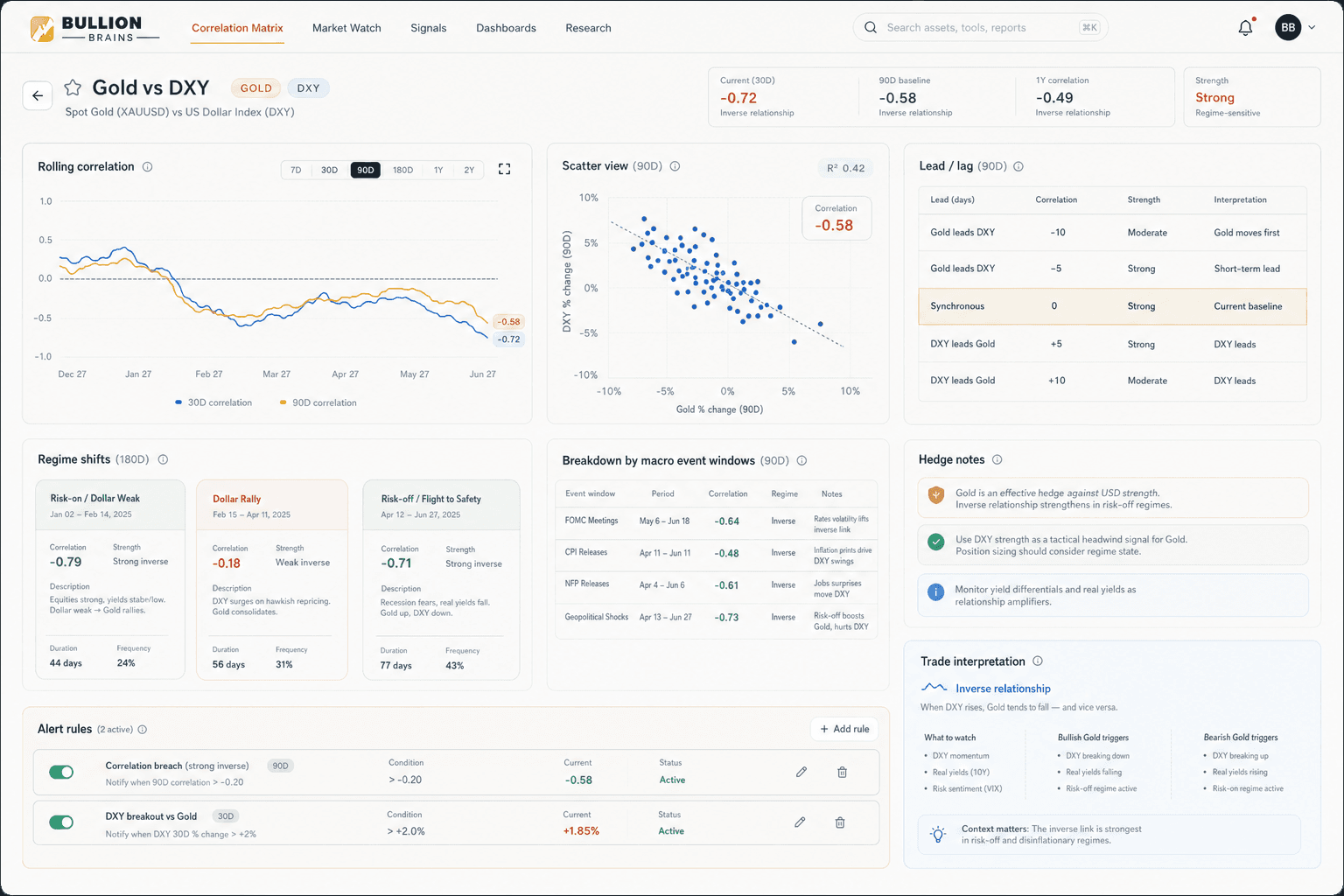
Bullion Brains extends the matrix into rolling correlation and multi-period comparison so the desk can see whether the linkage is strengthening, weakening, or breaking down into a different regime.

Track 30-day rolling behavior across a longer historical sample to catch regime shifts early
Compare short-term and long-term readings before trusting a static average
Use range, extremes, and current-regime labels to see whether the relationship is stable enough to lean on
03

Translate the relationship into hedge, sizing, and trade logic

The deeper tabs turn correlation into decision support with beta, diversification scoring, divergence analysis, lead-lag behavior, and trading signals when the market moves out of line with expectation.

Use beta and scenario logic to estimate how fast one asset should move relative to another
Check diversification score before assuming the book is safer just because it has more tickers
Read divergence and lead-lag signals when the market is stretching away from its usual relationship
Regime depth
Bullion Brains correlation workspace showing regime depth, beta, diversification, and signal context

Correlation Desk Depth

A correlation tool only becomes useful when it tells the trader what to do with the relationship.

Bullion Brains turns cross-asset analytics into a desk-grade layer for commodity traders. The point is not just to label a pair as positive or negative. The point is to show whether the relationship is tradable, stable, diversifying, or breaking down into a signal.

Heatmap and matrix

See the full cross-asset map, not just one pair, so clusters and outliers stand out immediately.

Rolling regimes

Track how correlation is changing over time so the desk can tell a living regime apart from an outdated average.

Beta and diversification

Use sensitivity and portfolio-mix context before assuming a hedge or basket is actually reducing risk.

Signals and divergence

Read lead-lag, divergence, and mean-reversion style signals when the relationship departs from what the desk expects.

Connected Workflow

Correlation is strongest when it sits beside pricing, timing, and execution research.

Cross-asset context is a conviction layer. Bullion Brains lets traders move from relationship analysis into local pricing dislocation, strategy validation, and the platform workflow they use when the edge becomes part of the routine.

Cross-check fair value when local bullion is moving with or against the wider cross-asset relationship
Push strong relationship ideas into the backtester when the setup needs rules instead of narrative
Move into the right platform plan when rolling regimes and signal tabs become part of the daily desk

Search questions

Answers for gold, silver & cross-asset correlation searches

The checks traders usually run before they lean on a correlation reading for local market gold, local market silver, FX, or a COMEX contract.

What is a correlation matrix in trading?

A correlation matrix is a grid showing how every pair of assets in a set has moved together over a chosen window. Each cell holds a correlation coefficient between -1 and +1: +1 means the two moved in lockstep, 0 means no linear relationship, and -1 means they moved in opposite directions. Bullion Brains computes the Pearson correlation on daily returns rather than on raw prices, because two assets in a shared uptrend can look correlated on a price chart while their day-to-day moves are unrelated.

How correlated are gold and silver?

Gold and silver are usually strongly positively correlated — long-run studies put the coefficient near 0.9 — because both are priced as precious metals against the same dollar and real-rate backdrop. The relationship is not constant, though. Silver carries an industrial-demand component gold does not, so correlation tends to loosen when the driver is industrial rather than monetary. Bullion Brains reports the coefficient for the window you select alongside a rolling series, so the current regime is visible instead of assumed.

How do you read a correlation coefficient and its p-value?

Read the sign first, then the strength, then whether the sample supports it. Bullion Brains labels an absolute coefficient of 0.8 or above as very strong, 0.6 to 0.8 as strong, 0.4 to 0.6 as moderate, and anything below 0.4 as weak. The p-value reported next to each pair estimates how likely a relationship that strong would appear by chance in a sample that size — a small p-value means the reading is statistically meaningful, while a high one means the pair does not yet have enough data behind it to lean on.

What is the difference between the gold-silver ratio and gold-silver correlation?

They answer different questions. The gold-silver ratio is a level — how many ounces of silver one ounce of gold buys — and it is used to judge relative value. Correlation is a behaviour measure: whether the two prices move together day to day, regardless of how far apart their levels have drifted. The ratio can stretch to an extreme while correlation stays high, because both metals can rise together with one rising faster. Bullion Brains treats them as separate layers rather than substitutes.

How is gold correlated with FX for local market traders?

For an local market trader the FX link matters as much as the COMEX one, because local market gold is quoted in local currency while the global benchmark is quoted in dollars. A weaker local currency mechanically lifts the local currency price of the same ounce of gold, so local market gold can hold up on a day COMEX gold falls. Bullion Brains includes FX directly in the asset universe alongside gold, silver, crude oil, copper, platinum, palladium, and natural gas, so the currency leg is measured rather than inferred.

What is a rolling correlation and which window should you use?

A rolling correlation recomputes the coefficient over a moving window so you can see the relationship change through time instead of collapsing it into one average. Bullion Brains offers 20, 30, 45, and 60-day rolling windows across 60 to 180-day lookbacks. A shorter window reacts faster to a regime change but is noisier; a longer window is steadier but lags. Comparing a short and a long window is what reveals whether a relationship is genuinely breaking down or just wobbling.

What does beta tell you that correlation does not?

Correlation tells you whether two assets move together; beta tells you how much. A pair can be almost perfectly correlated yet have one asset moving twice as far on the same day, which is exactly the case that surprises a position sized on correlation alone. Bullion Brains reports beta beside the correlation reading so magnitude and direction are read together, which is what matters when judging how a move in one contract is likely to scale into another.

Does a low correlation mean a portfolio is diversified?

Not on its own. A low pairwise correlation over one window can hide the fact that several holdings share a common driver that only shows up under stress, when correlations across risk assets tend to converge. Bullion Brains reports a diversification score across the whole selected set rather than pair by pair, and pairs it with divergence and lead-lag readings — but correlation is relationship context for framing risk, not a safety guarantee or a trading signal.

Cross-Asset Edge

Start with the market web, then decide whether the move deserves conviction.

Open the Bullion Brains correlation desk, read the regime, and act only when the relationship holds up under real trader scrutiny.