What is a commodity strategy backtester?
A commodity strategy backtester replays a precise, mechanical rule over historical price data and records what that rule would have done, trade by trade. It converts a loose opinion such as "gold tends to firm after a pullback" into something measurable: an exact condition, a defined holding period, and a full record of every occasion the condition occurred. Bullion Brains applies this to gold, silver, platinum and palladium, so an local market or COMEX idea can be checked against history before it is trusted.
Which indicators can you use to build a rule in the Bullion Brains backtester?
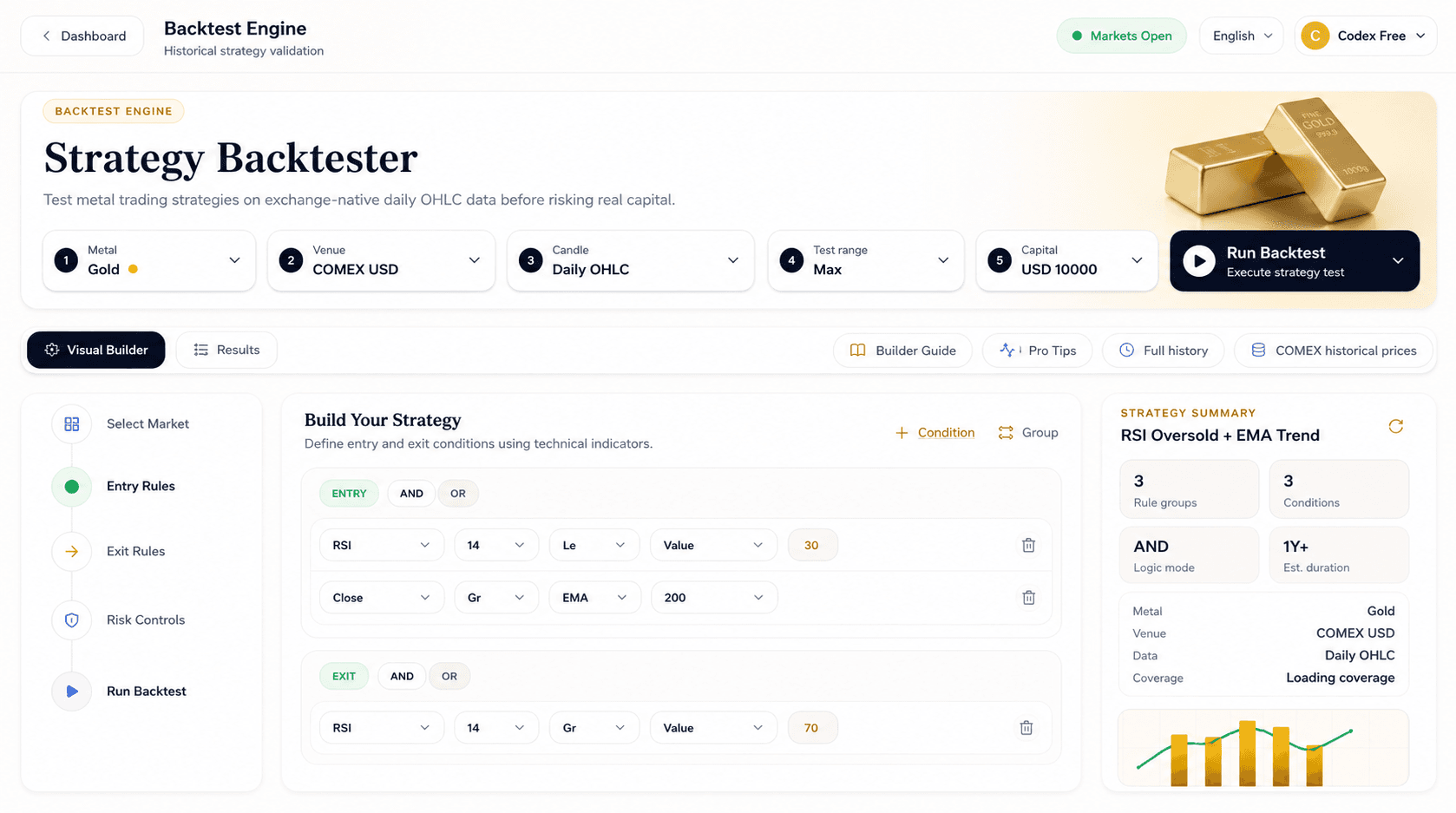
The builder exposes 30 inputs across six families: moving averages (SMA, EMA); momentum (RSI, MACD with its signal and histogram, Stochastic %K and %D); volatility (ATR, and the upper, middle and lower Bollinger bands); raw price data (open, high, low, close, volume, plus the prior session's high and low); pivot levels (the CPR central pivot with its top-central and bottom-central bands); and a seasonal and macro family (month, day of month, day of year, days to and from a scheduled event, whether a date falls inside an event window, and whether it falls in a historically favourable month). FX is available as its own input, which is what lets an global markets-specific rule reference the local currency leg directly.
How do you turn a trading idea into a testable rule?
Each condition compares two things using one of five comparators: greater than, less than, equals, crosses above, or crosses below. The right-hand side can be another indicator or a fixed value, so "RSI crosses above its own level" and "price crosses above the 50-period SMA" are both expressible. Conditions are then combined into AND/OR groups that can be nested, which means a multi-part idea stays one rule instead of several loosely related ones. A rule is only testable once it is unambiguous -- every condition has to resolve to true or false on each bar with no judgement left over.
Which commodities can you backtest on Bullion Brains?
Four metals are supported: gold, silver, platinum and palladium. Because the same rule can be run across all four, a pattern that only appears in one metal can be separated from one that holds across the precious-metals complex -- a useful check on whether an idea reflects something structural or just one market's history.
What performance metrics does a backtest report?
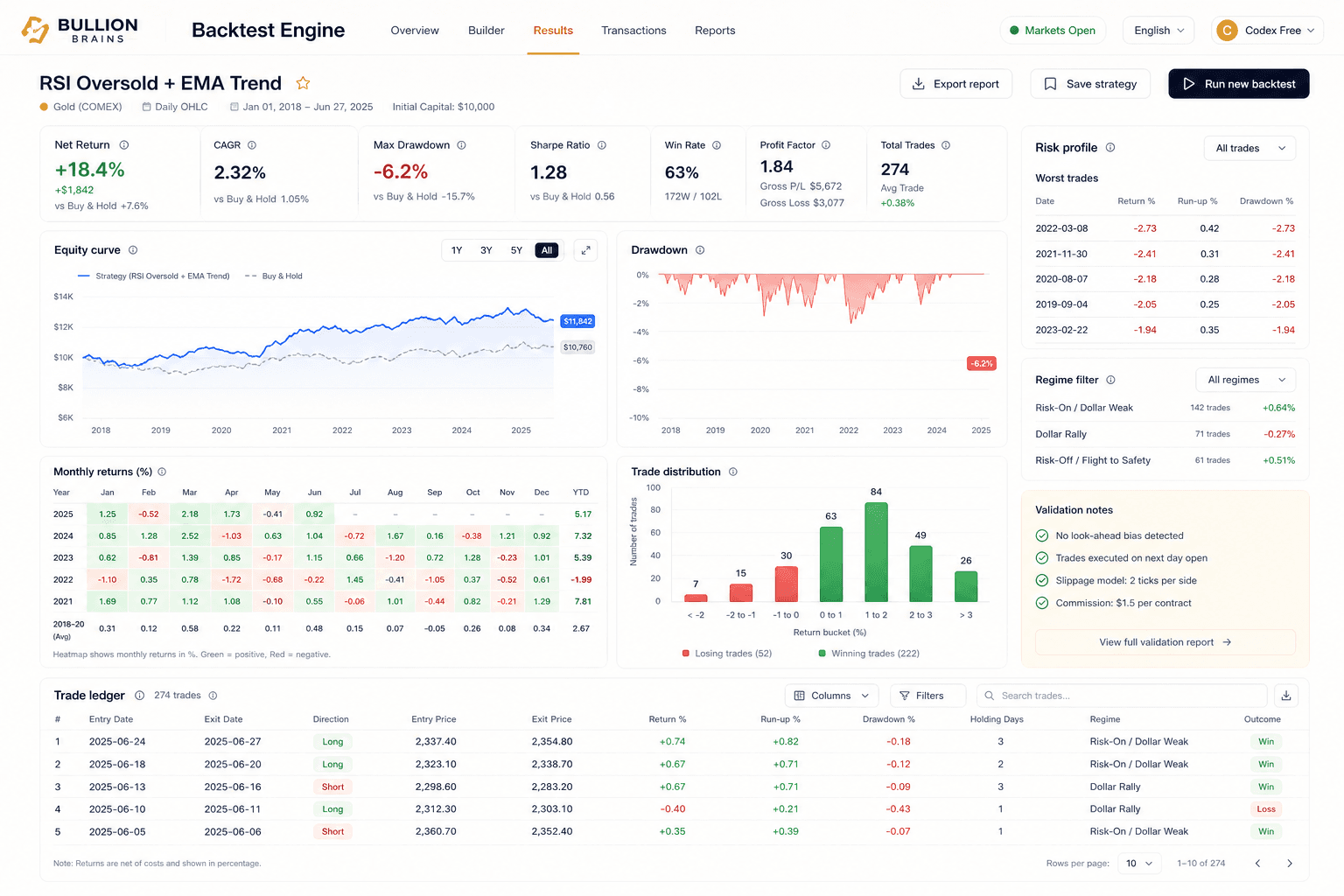
Every run returns five headline metrics -- total return, win rate, maximum drawdown, Sharpe ratio and the number of trades -- alongside a full equity curve that carries the drawdown at each point, and the individual trade record. The number of trades is the one to read first: a metric computed over a handful of occurrences describes those occurrences, not a reliable tendency. Maximum drawdown deserves the second look, because it describes the worst stretch the rule would have had to be held through.
Does the backtest include trading costs?
Yes. Commission and slippage are both modelled as configurable percentages rather than assumed away, and they are applied per trade. This matters most for high-frequency rules: a strategy that trades often can look strong before costs and unremarkable after them, and the difference between those two versions is usually the honest answer about whether the idea is worth pursuing.
Why does a strong backtest result often not repeat in live markets?
Usually because the rule was fitted to the sample rather than discovered in it. The more parameters that get adjusted until history looks good, the more the result describes that specific stretch of past data. Three checks reduce the risk: look at how many trades the result rests on, test the same rule on a period that was not used while designing it, and consider whether the market regime that produced the result still holds. A backtest is historical evidence about a rule, not a forecast of what it will do next.
Can you backtest seasonal or event-driven rules?
Yes -- the seasonal family is built for exactly that. A rule can reference the calendar month, the day of the month or year, how many days remain until or have passed since a scheduled macro event, whether a date sits inside an event window, and whether it falls in a month that has historically been favourable. Combined with the FX input, this makes it possible to test global markets-specific seasonal ideas -- festival-period behaviour, or how a rule performs when the local currency is moving -- rather than assuming the COMEX seasonal pattern carries over to local market unchanged.