Do local market gold prices track import parity?
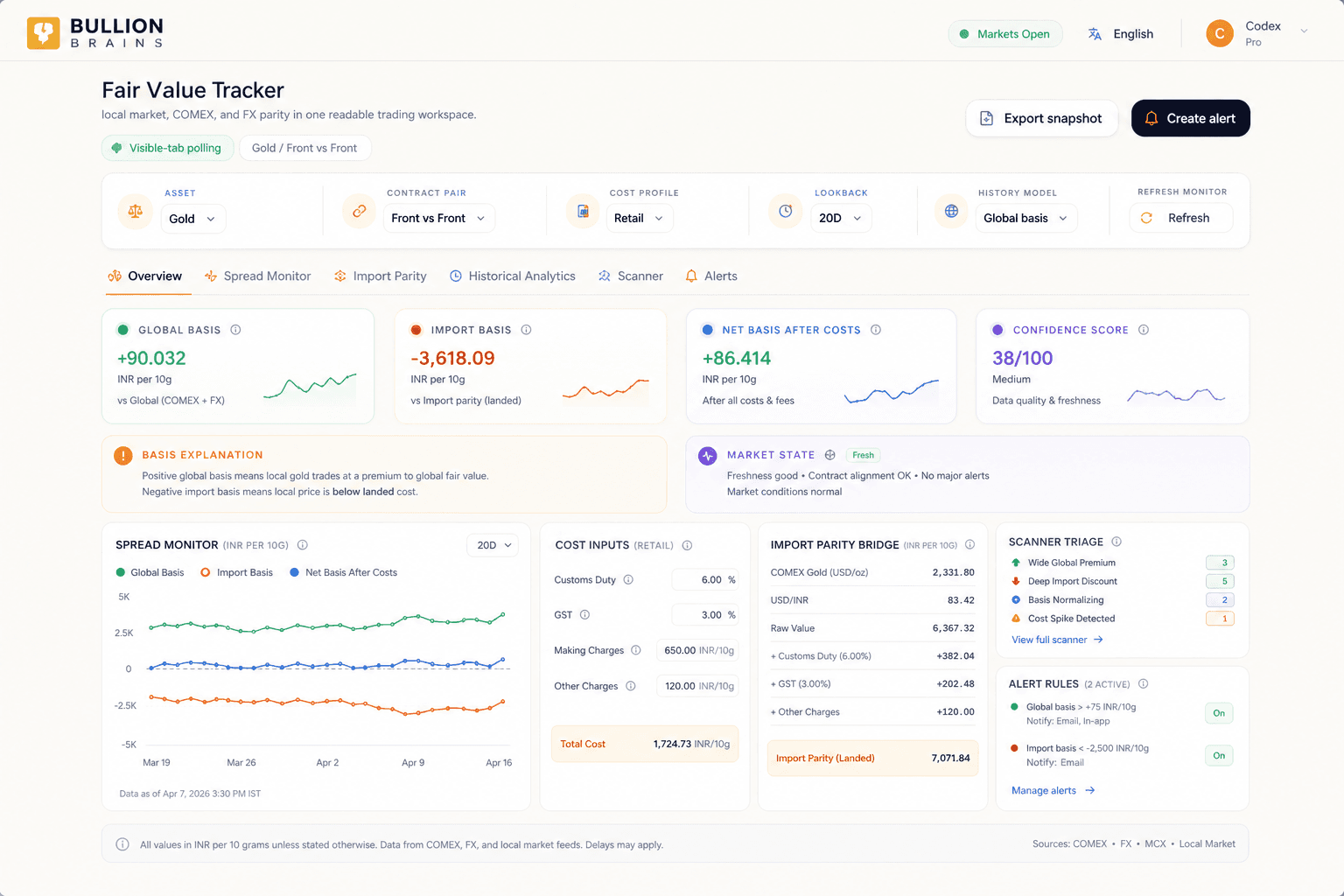
local market gold prices often track import parity directionally because local futures reflect global gold, FX, unit conversion, landed-cost assumptions, and contract liquidity. The useful check is the spread between the active local market contract and the parity band, not a single fixed fair-value number.
What does local market gold tracks import parity price mean?
It means the local local market gold futures price is being compared with a landed fair-value estimate built from global gold, FX, unit conversion, and import-cost assumptions. Bullion Brains turns that comparison into a basis workflow so traders can see whether local market is tracking parity, trading rich, or trading cheap.
What does local market gold price relation to import parity mean?
local market gold price relation to import parity means the active local futures price is being compared with a landed fair-value reference, then read through basis, contract month, liquidity, and data freshness. The Arbitrage Calculator keeps those assumptions visible before a trader treats the spread as meaningful.
What does local market gold futures premium discount to import parity mean?
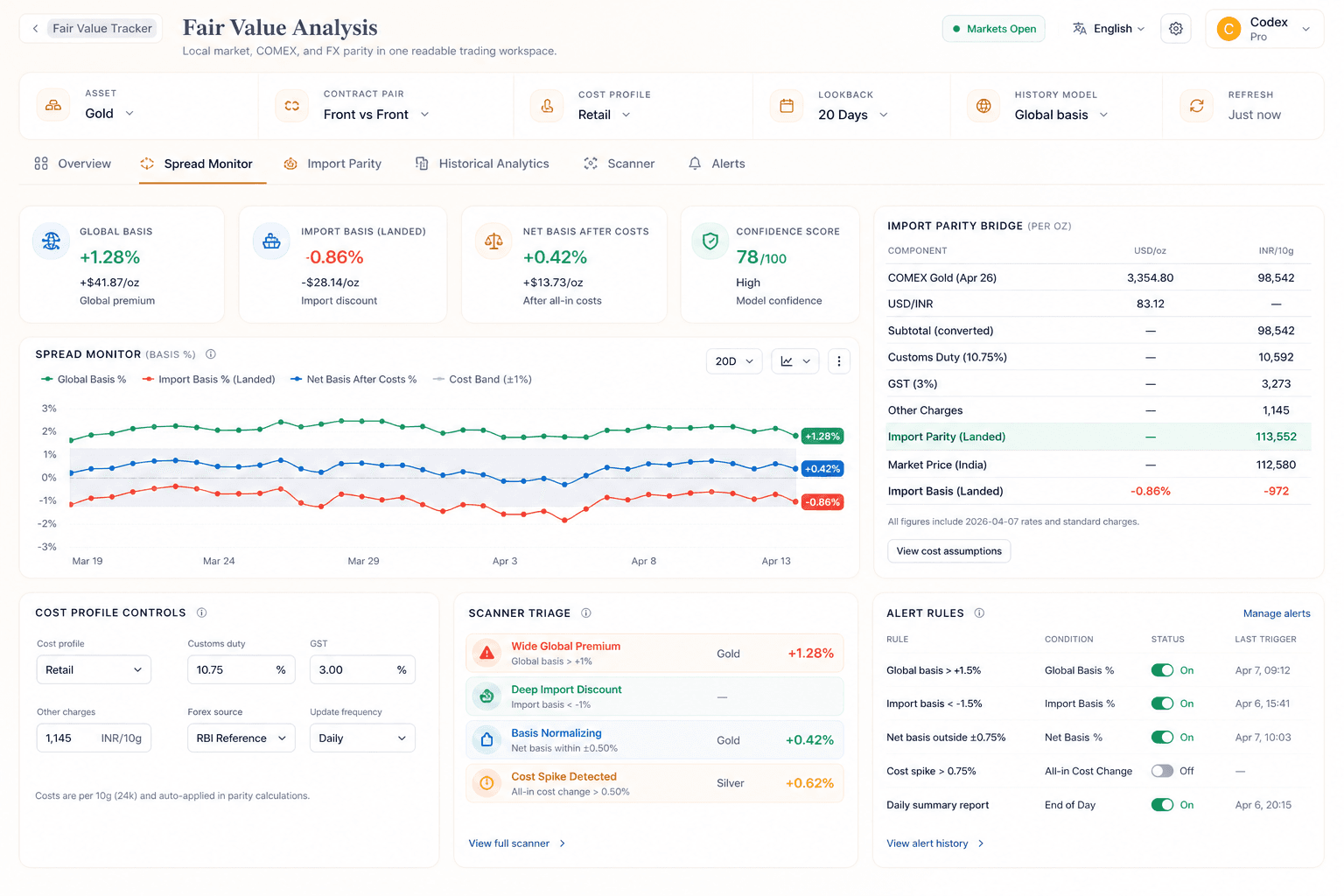
local market gold futures premium discount to import parity means traders are checking whether the active futures contract is rich, cheap, or broadly aligned with the import-parity estimate. Bullion Brains shows that premium or discount beside spread history, confidence, FX timing, and regime context.
What does local market gold premium discount to COMEX parity mean?
local market gold premium discount to COMEX parity means the active local market contract is being compared with a COMEX-led fair-value reference after FX, unit conversion, landed-cost assumptions, contract month, liquidity, and data freshness are checked.
What does local market gold premium discount to international parity mean?
local market gold premium discount to international parity means the local local market gold contract is being compared with a broader global fair-value reference, then read through FX, costs, timing, and basis history to see whether it is rich, cheap, or aligned.
What does local market gold premium to import parity mean?
local market gold premium to import parity means the local futures contract is trading above the modeled landed fair-value reference. The Arbitrage Calculator keeps the premium, discount, contract month, source freshness, and recent basis behavior in the same view.
What is local market gold price versus import parity price?
The local market gold price is the traded local futures price. Import parity price is a fair-value reference built from global gold, FX, conversion, duty, and landed-cost assumptions. The difference between them is the basis traders monitor for rich or cheap local pricing.
What does local market gold premium over international price mean?
It means the active regional futures contract appears rich versus a global gold reference after currency conversion and landed-cost assumptions. Traders should compare the premium with FX timing, contract month, liquidity, data freshness, and recent basis history before treating it as a real dislocation.
How do traders calculate local market gold import parity?
A simplified import-parity structure starts with COMEX gold, converts the unit and currency through FX, then adds duty, taxes, financing, carrying, and local landed-cost assumptions. Bullion Brains keeps those assumptions visible before comparing the result with the active local market contract.
What is the COMEX to local market gold conversion formula?
The COMEX to local market gold conversion formula first aligns the global USD-per-ounce reference with the local market local currency unit through FX and unit conversion, then applies current landed-cost assumptions before comparing the result with the active local market contract. The inputs, contract month, and timestamp must be verified before reading the basis.
How does a COMEX gold to local market gold conversion formula work?
A COMEX gold to local market gold conversion formula is a transparent parity workflow rather than one permanently fixed number: align price units and currency, apply current duty and landed-cost inputs, choose the matching contract context, and compare the estimate with local market. Bullion Brains keeps each assumption and source timestamp visible so the estimate has clear context.
Why can local market gold trade rich or cheap to import parity?
local market can trade away from parity when FX timing changes, the active contract rolls, local liquidity thins, demand creates a premium, or data freshness weakens the read. That is why basis history, confidence, contract month, and macro timing matter before acting on the gap.
Is import parity a trading signal?
Import parity is a fair-value anchor, not a standalone trading signal. Traders should combine it with spread history, liquidity, pivots, positioning, event risk, and their own risk controls before treating any rich-versus-cheap read as actionable.